Monday, March 27, 2017

Reading Charlotte's Web as an Adult

Charlotte's Web by E.B. White
Date: 1952
Format: B&N collectible edition (omnibus)
How did I get this book? purchased
Rating: 4 of 5 stars

Charlotte's Web is one of the (many) classics I can't believe I never read as a kid. In fact, there are A LOT of classic children's books (chapter books, novels, and picture books) I "missed" growing up. Even some I may have read, I unfortunately don't recall very well. But instead of looking at them as missed chances, I'm taking the opportunity now to enjoy them as an adult -- and hopefully someday share them with my son. With that in mind, some months back, I revised my Classics Club list to focus on children's classics. Finally reading Charlotte's Web confirms this was a wise decision for me at this stage in my life.

Sure, there are plenty of more "difficult" classics I aspire to tackling someday, but that really isn't where my head is at right now. It's not just that children's classics are "easier" or shorter, though they often are -- and my tired mommy-brain is grateful! Wanting to focus on children's books is more about my frame of mind and priorities right now. Diving head first into picture books with my son as an infant, baby, and now toddler has reminded me how rich and engaging good children's literature can be. So many of these stories (and their artwork!) can be enjoyed by people of all ages, even if they aren't the first thing we might gravitate to as a "grown-ups."

My son may still be too young to appreciate a lot of the books I've been picking up lately, but that's not really the point. The point is that the more I learn about children's books, the more I want to experience them for myself and fill in some of the gaps in my own childhood reading. I know my parents took me to the library and read me picture books, but mostly I just remember reading Nancy Drew, The Babysitters Club, spooky books by Mary Downing Hahn, and the occasional school assignment I actually enjoyed, but that was later in my childhood. I remember my highschool reading vividly, but my younger years are understandably a bit foggy. So why not read those children's classics now? There is no good reason not to read them now, so that is exactly what I am doing and I'm really loving it.

The only (sort-of) downside to reading these childhood classics now is that there isn't any of the nostalgia factor. Charlotte's Web likely would have gotten 5 stars if I had read it as a child, but it was still a very well-written, engaging, and enjoyable story about friendship, determination, and loss. I never was much a fan of spiders, but this fictional tale has helped this scaredy-cat look at them a bit differently and reminded me of their purpose in the natural world. I appreciated that this story didn't sugarcoat some of the harsher realities of life and death on a farm, but it is ultimately a hopeful and uplifting book. It didn't turn me into a vegetarian, though at times I was wondering if the author was trying to! More E.B. White books are on my TBR for sure, namely Stuart Little and The Trumpet of the Swan -- both of which are also in the omnibus edition I read Charlotte's Web from.

In addition to the story, the illustrations for Charlotte's Web are just wonderful and I am fast becoming a fan of Garth Williams' work. Our bookshelves and library basket are filling up with his many picture books and we've found a few new favorites. My son and I have both enjoyed My First Counting Book and Home for a Bunny in particular and look forward to exploring more of this prolific illustrator's books.


Sunday, February 12, 2017

Show and Tell: Exploring the Fine Art of Children's Book Illustration

Show and Tell: Exploring the Fine Art of Children's Book Illustration by Dilys Evans
Publisher: Chronicle Books
Date: March 2008
Format: hardcover
How did I get this book? borrowed from library
Rating: 4 of 5 stars
GoodReads

This was a very informative exploration of picture book art focusing on 12 different illustrators. As the author states, this is not meant to be a "best of" list, but rather she chose a group of artists she felt offered "a wide range of styles, technique, and content" and I feel she certainly delivered on that. All of the featured artists may not be my particular favorites, but I definitely learned a lot by reading more about their work, background, inspirations, and process.

Only three of the featured artists were completely new to me (Trina Schart Hyman, Petra Mathers, and Harry Bliss), but this book piqued my interest in their work -- particularly the prolific Trina Schart Hyman whose chapter I found particularly intriguing. The other nine illustrators (Brian Selznick, Bryan Collier, Paul O. Zelinsky, Hilary Knight, David Wiesner, David Shannon, Betsy Lewin, Denise Fleming, and Lane Smith) I had previously read at least one of their books, but oftentimes it was their most popular work or their Caldecott award-winning work. So even for those artists I previously was somewhat familiar with, I've now been introduced to a broader range of their work. While I probably won't seek out every single one mentioned, I have certainly added to my picture book TBR list! I've already borrowed quite a few from the library and (shocker!) ordered used copies of two out of print titles my library system didn't have.

This sort of deep-dive into picture books and illustration won't be for everyone, but as someone who reads a ton of picture books these days -- both with my son and now on my own -- it is an area I want to learn more about. Out of habit, I still tend to focus on the text more than the art when I read a picture book. So the more I learn about illustration, the more I feel I can appreciate and understand it in its own right.

Sunday, January 15, 2017

Reading Paddington as an Adult

As a kid, I had a Paddington Bear stuffed animal -- in fact, I do believe it's still at my parents' house! We have pictures of me carrying him around (at the park, no less!), but I don't have any memory of reading the Paddington books as a child. If we did read any of them, they likely were the picture book adaptations and not the full-length novels. The picture books are lovely -- and I have a treasury of them on my son's shelves -- but I really wanted to read Paddington's full story and experience it for myself. 

Picture Book Collection

Once I saw that the audiobook of A Bear Called Paddington was narrated by Stephen Fry, I decided to go with that format. He is such a fantastic narrator (and boy do I wish I could listen to the UK audiobooks of Harry Potter he narrates!) and delivers this classic story flawlessly. The only thing missing is the illustrations of the print edition, so I ended up getting a lovely hardcover anniversary edition for our shelves as well. I'd love to get the full series in print someday, but have held off so far since I already have the next few books queued up in my Audible library. 

First full-length novel

The second novel, More About Paddington, is the only other one narrated by Stephen Fry and that is as far as I've gotten in the series thus far. In fact, I've now read them twice and they were just as good the second time through. While the first novel is surely the most well known and widely read, the follow-up was an equally wonderful reading experience for me. Although the books are divided into chapters to be read in sequence, most feel like they can be read as their own stories as well. Particularly once you are past the initial few chapters that introduce Paddington and the Brown family, they start to read more and more like individual adventures within the established framework. I feel much the same about the Winnie-the-Pooh books, as a matter of fact.


Paddington is an endearing character and I can certainly see why his popularity has endured through the decades. He has a knack for getting himself into trouble and it's always interesting to see how he gets himself out of that trouble -- one way or another. Like many well-loved children's book characters, he means well, but mishaps, misadventures, and misunderstandings happen -- and make for great storytelling along the way. The novels are definitely still far above my son's level, but I do look forward to sharing them with him someday. In the meantime, I will continue reading/listening to the rest of the series myself and I'll have to remember to pull down our picture book versions at storytime!

Classics Club #13-14

Tuesday, December 6, 2016

Reading the Art in Caldecott Award Books

Reading the Art in Caldecott Award Books: A Guide to the Illustrations by Heidi K. Hammond & Gail D. Nordstrom
Publisher: Rowman & Littlefield
Date: August 2014
Format: print
How did I get this book? borrowed from library
Rating: 5 of 5 stars
GoodReads | Authors | Publisher

I am participating in Julie's Newbery/Caldecott Challenge this year and was looking to learn more about why certain books win these awards when I found Reading the Art in Caldecott Award Books in my library system's catalog. I borrowed it at least three times and maxed out my renewals each time. Even though I have now read it in its entirety, I am seriously considering buying a copy to have as a reference. It seems to be an academic-type book though, so it is rather pricey for a paperback -- used or new -- so I'm holding out for now. I admit I am exceedingly enthusiastic about picture books these days, but regardless, I still feel like this is a real hidden gem of a book. Realistically, I imagine this book has mostly been used by librarians and teachers, but I think it could have wider appeal to parents if not for the price. Delving more deeply into picture books isn't for everyone, but I'm sure I'm not the only bookish parent who is more comfortable with understanding and appreciating text and wished to know more about the merits of award-winning illustration.

So what exactly will you find in this book? The introduction covers the Caldecott award criteria and the process of choosing the winners. The authors share their own experience serving on the 2011 Caldecott committee (without revealing anything confidential, of course). I know it takes a lot of hard work and dedication, but it sure sounded like fun for anyone who loves picture books! The authors also explain how and why they wrote the book and how to use it. It is important to know it is not meant to be read alone, but rather to be read alongside the picture books themselves so you can examine the illustrations more closely as you learn more about them.

After the introduction, we move right into entries for 56 different Caldecott award books. The entries are presented alphabetically by title and include all of the Medal and Honor books for 2011-2014 plus selected titles from earlier years. It doesn't cover nearly all of the Caldecott titles going back to 1938, but there is enough here to give you a solid foundation for better understanding how the award works and what qualifies a book to receive it. I would love if the authors wrote a follow-up featuring additional Caldecott books, but I don't know how realistic that wish is!

Each entry lists the title, author, medal or honor status, year, style, and medium. Then there four sections: "analysis," "for further consideration," "illustrator note," and "sources consulted." Each entry is not long, but they are packed full of insights and observations about the book and its artwork. You can read the entry for The Invention of Hugo Cabret excerpted on the authors' website here to see an example.

My usual method was to read the picture book once, then read its entry while flipping back through the picture book and examining it more closely. I cannot even begin to count how many times I missed things in the illustrations. And while most of the time, I felt like my biggest takeaway was to just pay better attention already! -- there were many other cases where additional background information was provided that I never would have known without additional research. And as easy as it sounds to just pay better attention, many years of focusing primarily on the written words is a hard habit to break. The other thing this book was really good at was pointing out "threads" in the illustrations -- for example, a minor character or image that appears on every page. I am terrible at picking up that sort of thing on my own unless it is glaringly obvious. I am definitely not well-practiced in noticing more subtle things in picture book artwork.

There is a glossary which proved extremely useful as I encountered unfamiliar terms. There are also three different indexes so you can easily identify picture books by media and style as well as by title/author/illustrator. The "sources consulted" listed for each entry (in addition to the sources listed in one of the back appendixes) are proving to be a treasure trove of additional reading. I've started looking for some of them in my library system and plan to continue delving into the world of picture books. I have a feeling I've started down a bit of a rabbit hole here, but I'm definitely OK with that. Apologies to anyone who isn't so interested in picture books, but this "genre" is even more vast and more fascinating than I first imagined and I won't be leaving it any time soon!

Monday, November 28, 2016

Current Children's Book Favorites

I always thought I would never tire of reading to my son, and for the most part that is still true. I know toddlers and little kids thrive on repetition, so I'm not surprised he gravitates toward the same books over and over. However, I must admit when we get to the fifth reading in a row, I very much do wish we could switch to something different! He does have many favorites though, so I really can't complain. I am so thankful my little boy enjoys stories, being read to, and (most of the time) snuggling up for this part of our day. So I thought I would share the most recent batch we -- sorry, he -- has on rotation.


Hippos Go Beserk! by Sandra Boynton
What's Wrong Little Pookie? by Sandra Boynton
One, Two, Three by Sandra Boynton
Barnyard Dance by Sandra Boynton
Little Blue Truck by Alice Schertle & Jill McElmurry (Illus.)
I Love You Through and Through by Bernadette Rossetti-Shustak & Caroline Jayne Church (Illus.)
Zoom Buggy! by Claire Clark & Jay Jung (Illus.)


Ten Little Fingers and Ten Little Toes by Mem Fox & Helen Oxenbury (Illus.)
Little Blue Truck Leads the Way, by Alice Schertle & Jill McElmurry (Illus.)
We're Going on a Bear Hunt by Michael Rosen & Helen Oxenbury (Illus.)

Not pictured:
Five Little Ducks by Raffi and Jose Aruego & Ariane Dewey (Illus.)

The first photo was actually taken a month ago, so the second photo shows additions since then. A few in the second photo, he honestly didn't care for at first. It's amusing to see him reject a book (translation: shut it mid-sentence) only to warm up to it later. I'm stubborn about expanding his repertoire though. I know he is protesting for no other reason than because the story doesn't sound familiar, so I just keep trying. Sometimes I read new books when he is more sleepy and agreeable to letting me choose our story. Other times, I sit in the rocking chair and read aloud while he plays in the same room. And plenty of times, a "rejected" book has become a new favorite. So I always try to remember that when I excitedly crack open a new book, only to have him pull it away, shut it, or declare "no, no, no!"

* * * * *

If anyone has any children's book recommendations, I'd love to hear them! And I hope everyone celebrating had a lovely Thanksgiving :)

Saturday, October 29, 2016

Some Halloween Reading

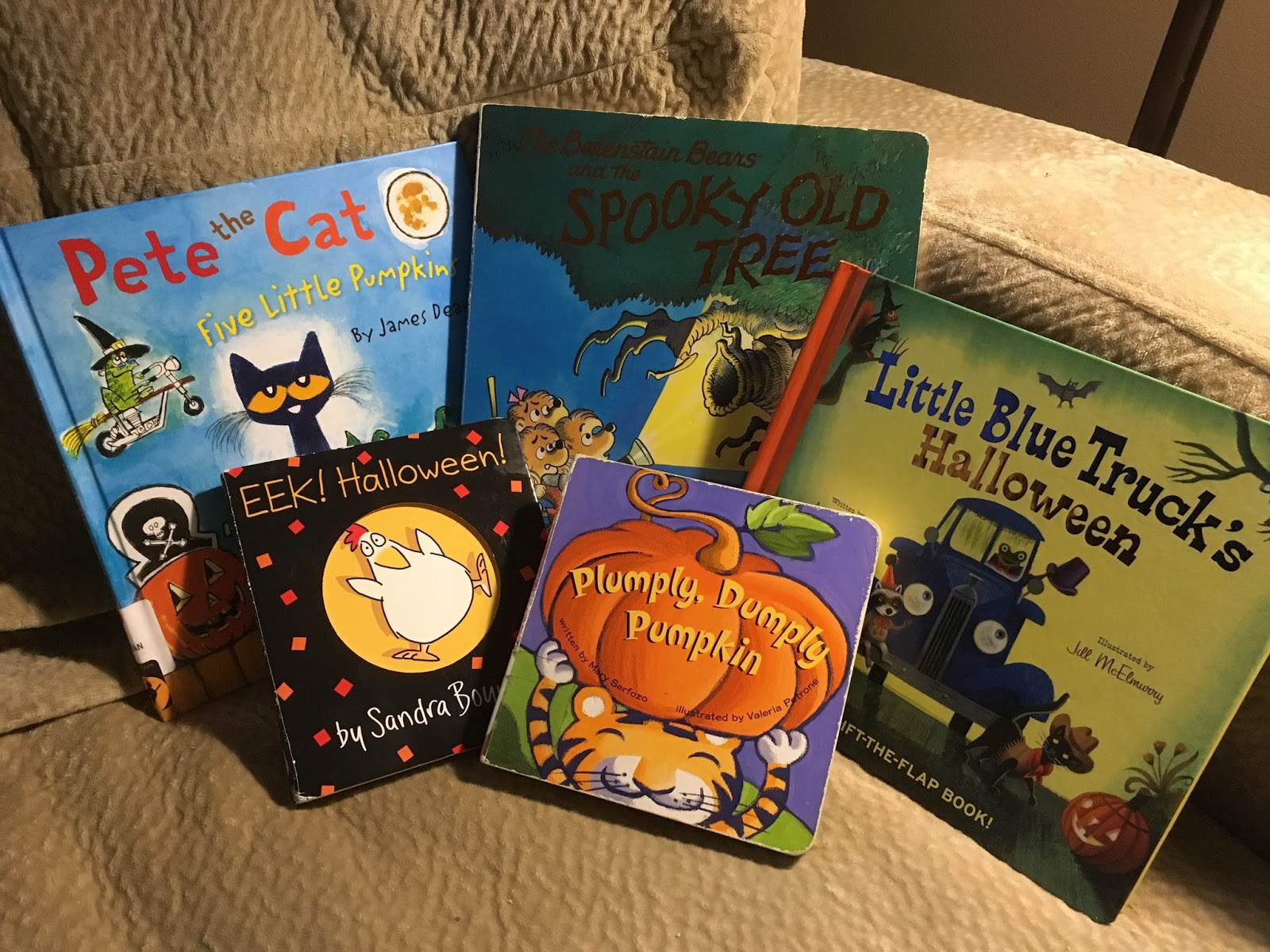
I love reading for the seasons and holidays, but must admit I'm much better at keeping on top of the calendar with children's books than my own "adult" books! With Halloween on Monday, I thought I'd share some books in our rotation lately:


Berenstain Bears and the Spooky Old Tree, by Stan & Jan Berenstain
Little Blue Truck's Halloween, by Alice Schertle & Jill McElmurry (Illus.)
Eek! Halloween!, by Sandra Boynton
Plumply, Dumply Pumpkin, by Mary Serfozo & Valeria Petrone (Illus.)

Not shown/returned to library:
Room on the Broom, by Julia Donaldson & Axel Scheffler
Llama, Llama Trick or Treat, by Anna Dewdney
It's Pumpkin Day, Mouse!, by Laura Numeroff & Felicia Bond (Illus.)
Five Little Monkeys Trick-or-Treat, by Eileen Christelow

The majority of these have been read more than once and quite a few have been read repeatedly. My son's favorites are definitely Little Blue Truck's Halloween and Eek! Halloween! For these (and other favorites), he brings them over to Mommy or Daddy and climbs into one of our laps to be read to. It's pretty much one of the cutest things I have ever seen. Little Blue Truck's Halloween is from the library, but I'm thinking we should get a copy for our Little Blue Truck collection based on his enthusiasm. I just picked up Little Blue Truck's Christmas when I saw it at Marshalls in preparation!

And just last night, I actually did start a spooky book of my own!


So far, I've read the intro and one of the fourteen stories (I skipped to the shortest one!) I love the idea of dipping in and out of this collection and it doesn't matter to me if I don't finish it by Monday (which I probably won't!) I don't read a lot of short stories, so I'm glad to be giving this a try and branching out a bit. Collections of stories, poems, or essays always seem like a good idea to have going alongside other longer works, but I never seem to get one started. Maybe this one will help me get the ball rolling. Thanks Jade for the recommendation!

* * * * *

Do you have any favorite Halloween or fall books?

Sunday, May 1, 2016

Reading Winnie-the-Pooh as an Adult

As popular as Winnie the Pooh was when I was a kid, I never actually read any of the original stories until very recently. I remember Pooh cartoons and Pooh stickers (stickers were SUCH a thing with the girls when I was in grade school -- does anyone else remember this???) And if my parents ever read me any Pooh books, they were likely picture book adaptations.

So of all the books we received at our son's baby shower last year, I was most looking forward to reading the original Winnie-the-Pooh friends of ours gave us. And with such a beautiful edition to start our collection, I just couldn't resist adding The House at Pooh Corner as well as the two volumes of poetry When We Were Very Young and Now We Are Six. I was a little amused to see two of the used copies I bought were actually inscribed because they looked like they were barely even opened, let alone read. I look forward to the day my son asks me who Rosie or Jack & Whitney are -- I don't know kid, but they were missing out on these books, I can tell you that much.

The Stories

Now, I knew Winnie-the-Pooh and The House at Pooh Corner were not particularly short, but I was still surprised to realize they were each close to 200 pages. Both volumes are divided into 10 chapters, each of which is its own story. They are connected, but I think they could be read on their own as well. The writing style is sort of meandering which definitely took some getting used to, but I thoroughly enjoyed these stories once I got the hang of the dialogue. I struggled a bit reading them aloud, so it's good my son is a bit too young to notice! These are true classics that I know I will reread more than once. In fact, I've already listened to the first volume on audiobook. The professional narrator did a much better job than I did for sure! The Piglet noises were a little jarring, but the audio does bring the characters and stories to life. Between reading and listening, it is so clear to me now how the cartoon versions of these characters evolved from the source material.

The Poems

As for Milne's poetry, I didn't know much at all beforehand except that When We Were Very Young and Now We Are Six are part of the Pooh collection. Now having read them, I think that's actually a bit of a stretch. Pooh and Christopher Robin make a few appearances, but that's about it. The majority of the poems have nothing to do with Pooh and cover a variety of other topics. They were still enjoyable, but not quite what I was expecting. I think they will only improve with rereading because I'll know better what I'm getting myself into. Also, I know I have a tendency to rush through poetry, so I'm certain there is more to appreciate in these volumes than I absorbed the first time around.

Now that I have read these four, I'm on the fence about trying The Return to the Hundred Acre Wood. It is a companion volume written 80 years after The House at Pooh Corner by another author, but supposedly captures the style of the originals in a series of new adventures. If any Pooh aficionados have an opinion one way or the other, please let me know what you think! And of course, I'm intrigued by the Winnie the Pooh cookbook, but maybe I'll just see if the library has that one.

Classics Club #9-12

Tuesday, March 15, 2016

A Gift from a Friend

Mid-January, one of my husband's closest friends (and his best man at our wedding) passed away unexpectedly. As hard as it is to bury a friend at such a young age, my heart was broken for his friend's parents. No parent should ever have to bury their child -- no matter how old or how young, it's a grief that is unimaginable to me and every parent's worst nightmare.

Like everyone, my husband and his friend had their ups and downs and their phases when they kept in touch better than others. You always think there's more time, right? More time to plan that trip to visit, more time to make that phone call, etc. I will be forever grateful that my husband's friend did meet our son after he was born last spring. It had been a while since we saw him, but it was such a wonderful visit. He and his mom spoiled our little guy with gifts, including one particular toy that has become a favorite and I think of him every time our son plays with it. 

Then for Christmas, we got a package in the mail with a sweet note and gift cards to Barnes & Noble and Target. It's very likely we might have used the Target card for practical things like diapers, but when a few short weeks later, this friend had passed away, I knew I wanted to make his last gift something we would hold onto for years to come. My best friend helped us brainstorm and we decided on classic children's books of the silly/goofy/fun variety. Shel Silverstein sure fit the bill, as did Matilda, Charlie and the Chocolate Factory, and Pippi Longstocking. I hadn't heard of A Long Way from Chicago before, but the description sounded like it would fit right in with the others. What better way to remember a friend than by reading a story and sharing a laugh?


And remember what I said about always thinking you have more time? Well, my husband stayed in touch with his friend a lot by text, so he thanked him right away. I wanted to send a thank you note also, but I'm the kind of person who remembers and forgets things at least a three times before they actually get done (especially if I don't write it down). And who ever thinks if you take a couple weeks to send a note, that you'll never get the chance? I know it had never even crossed my mind. So even with a busy schedule and a 10-month old to chase after, I've been trying to be better at not making excuses and putting things off. Make that call, send that note, plan that visit -- you won't regret it. And don't take friends or family for granted because you just never know what tomorrow might bring.

Saturday, March 5, 2016

Audiobook Review: The Reading Promise

The Reading Promise: My Father and the Books We Shared,
by Alice Ozma & Jim Brozina
Publisher: Grand Central Publishing
Date: May 2011
Format: Audio -- 7 hrs 1 min
How did I get this book? purchased with Audible credit
Rating: 4 of 5 stars
GoodReads | Author | Publisher

So, I had a $1 paperback copy of this one from a library sale that I'd been meaning to read for the longest time. A bookish memoir is right up my alley, but I finally admitted this is exactly the sort of book I really love listening to on audiobook. So I set aside the print copy for my Mom and Grandma to read and used one of my Audible credits on it instead. In a nutshell, this is the true story of a father and daughter who make a pact when she was 9 years old to read together for 100 days, then 1,000 days, then all the way until the day Alice leaves for college.

Most of the book is read by Alice, but the introduction and quotations at the beginning of each chapter are read by her father who is an elementary school librarian -- what a gift he has! I could see from these brief glimpses why his daughter, students, and other audiences have enjoyed his reading aloud so much. The book addresses a lot of family issues and difficulties -- everything is not just sunshine, roses, and bedtime stories -- but through it all, they honored this promise they made to each other and kept their "Streak" alive for years. 

This was an inspiring and heartwarming memoir I'm so glad I finally read. In fact, I may have enjoyed it even more now that I'm a mom. I was only about six minutes in and getting a little teary-eyed! It's not really a tear-jerker, but hearing Jim talk about the importance of reading and spending time with his children tugged at my heartstrings. I already read a lot to my 10 month old son, but this makes me want to continue the tradition as long as I possibly can (translation: as long as he will let me!)

Tuesday, February 2, 2016

A New Year's Bookshelf Clean-Out + Where to Donate Books

Like many avid readers and book collectors, I've always been a little defensive of my overflowing shelves. No matter how well-meaning or innocent, I tend to have a knee-jerk reaction to comments or questions about how many books I own, feeling the need to explain and justify my hobby. "There are worse addictions to have than my addiction to books!" is a phrase I have used many times. And I use the term addiction very loosely because true addiction is no laughing matter -- it's not like reading or books are ruining my life, relationships, or finances. Rather, books and reading enrich my life and bring considerable enjoyment to my days. Books are a joy to share with my young son, other family members, and friends, not to mention all the like-minded book nerds I've "met" through blogging.

I am so very fortunate to be educated and literate with access to a fantastic library system and the means to buy books as well. While I have gotten a little click-happy with ordering books online more times than I'd like to admit, I always feel good about supporting local book stores. I love browsing and discovering some hidden gem or interesting title I had never heard of before. The odds of this sort of serendipity occurring seems to increase if I'm in a used bookstore which just adds to the fun.

However, I recently realized (again!) that I no longer had any shelf space left. As Andy Miller wrote in The Year of Reading Dangerously, "I had confused 'art' with 'shopping'. Books, for instance. I had a lot of those. There they all were, on the shelves and on the floor, piled up by the bed and falling out of boxes." While my collection is fairly well contained, I couldn't help but see myself a little bit in Andy's observation. Book shopping is fun in its own way, but it doesn't hold a candle to the actual reading. That's the really fun part.

So what's a bookworm to do? Cull, cull, and cull some more. If you're looking for some ideas of where to send books, here's where this round of culling is headed:

1. Schools via Reach A Reader's ARCs Float On
Bloggers, check this program out! This is a great way to responsibly deal with review books you are done with or that are so far past their publication date that it's time to let them go. I chose to offer the teachers I contacted finished books as well since I have so many to pass on right now. Personally, I'd rather pay for media mail shipping and know my old ARCs are going someplace they are wanted, than to push them on local schools that aren't actively seeking out or willing to accept them. I contacted three different teachers, received prompt responses, and have been busily boxing everything up to get into the mail. If there is a teacher in the directory near you, you might even be able to drop them off. Reach A Reader also has many more resources listed here for additional donation options.

2. My grandmother's account at her local used bookstore 
I have an account there too, but seriously, I don't need any more credit than I already have! My grandmother shares an account with two of my aunts, so they often run out of credit. This particular store only takes paperbacks, so any books I didn't think would work for high schoolers, I have in a bag for the next time I visit. It obviously doesn't have to be your grandmother, but if you know someone with a trade account at a used bookstore, I'm sure they would appreciate a little bump to their balance if you have extra books to share.

3. My local used bookstore
This store takes hardcovers, so any of those that didn't seem like a good fit for a high school are going there. Mostly this has consisted of mid-life, middle age, finding-peace-after-divorce type of fiction -- which other than a familiar author name catching my eye, I don't even know why I even picked up these types of books and I'm considerably older than a high schooler! I don't send all my books here, but I do like supporting a small, independent business. 

4. My brother's girlfriend's mom
I found out she reads Nora Roberts and despite the fact that I used to read her books, I haven't picked any up in the past several years. My own mom has borrowed and read them all, so I'm glad others have and will enjoy them, but it's time for me to move on! It's definitely worth asking around if you want to share some excess books with friends and family.

5. Better Worlds Books donation bin in my library's parking lot
A handful of books I didn't think the schools or bookstores would want are going here. If they can't use the books in their online store, they get recycled, so this is often a last-ditch option for the odd stragglers I don't know what else to do with. See if there is a collection bin near you here.

SOME of the piles to be boxed up.

Some additional ideas:

1. Donate to a Little Free Library
A few months ago, I gave a friend a big pile for her Little Free Library, but I didn't want to overwhelm her with another avalanche of books. If you don't know anyone who runs a Little Free Library, you could start your own! Also, the whole premise of these libraries is "take a book, leave a book" so could always participate as a patron of any Little Free Library you come across. Search for one near you here.

2. Donate to a nursing home
Before I moved, I worked at a nursing home/rehabilitation center and we regularly received book donations to share with the patients and residents. I would recommend contacting them ahead of time to make sure they are willing to accept your books and have the space to store them, etc. You'd want to ask for the Recreation or Therapeutic Recreation (TR) Department.

3. Donate to a doctor's office or other organization
While I mostly think of magazines when it comes to waiting room donations, I know my son's pediatrician has a rack of picture books in every exam room. I haven't done this myself, but I'm sure when the time comes I could ask at the desk if they needed any additional books. If finding a local organization to share your books with is important to you (and you'd like to avoid shipping fees!), it can't hurt to ask! Call, email, or ask the next time you are visiting or nearby. Be aware they may decline your offer for various reasons (don't need any more books, don't want/need the types of books you are offering, don't have storage space, don't have anyone to sort/handle/distribute the donations, etc.), but you never know! If you inquire ahead of time, you give them the opportunity to evaluate whether or not they are willing and able to put your books to good use. Shelters, schools, after-school programs, day-care centers -- there a lot of options if you want to do some research.

4. Donate to a Library Book Sale
In my experience, a lot of libraries do NOT accept donations, unless they have a Friends of the Library group that coordinates book sale fundraisers. If your library does have a Friends group that runs these sales throughout the year, ask about how/where they accept donations. Some accept books year-round and others might have designated drop-off times or dates.

I feel like I was evaluating my collection pretty ruthlessly, pulling out well over 100 books, but I still have A LOT of books left in my house! So what the heck kinds of books are still on my shelves if I got rid of so many? I'm mostly keeping favorites, unread books I am still excited to read someday, and what I will loosely term "classics." That last category includes a LOT of children's books for various ages I'd like to share with my son as he gets older.

I am hoping this experience will help me to let go of books I'm done with more easily in the future and also be more mindful about future book purchases -- honing in on what is worth adding to (or keeping in) my collection versus what is just adding to the clutter. And let me tell you, knowing that so many of the books leaving my home would be going into classrooms made it SO much easier to let them go. That was my biggest lesson I think -- having a plan and knowing that any books I remove from my collection will be used and appreciated helped make my decisions about what to keep and what to give away so much easier.

* * * * *

Have you ever done a major culling of your book collection? Do you have any other tips, tricks, or donation suggestions to share? Please tell us in the comments!