Wednesday, June 28, 2017

Blog Love: Orange Marmalade

Some months ago, I stumbled across a blog that has fast become a favorite of mine. I really hadn't subscribed to children's lit blogs until this one and there are only a very select few others I follow. While I get some good info and recommendations from BN Kids, Brightly, and Imagination Soup, my far and away favorite is Orange Marmalade. I look forward to new posts from this blog more than just about any other -- and my library list explodes on a regular basis as a result! I've been paring down how many sites I subscribe to, but this one is staying in my Feedly queue for the long haul.


If you are a parent looking for children's book recommendations -- or even just interested for yourself, I cannot recommend it highly enough. Jill has a real heart and love for children's literature and it shines through in all of her posts. Her focus is on picture books through middle grade and she covers a very wide range of titles -- from classics and Caldecotts to brand new releases, books newly translated into English, poetry and art, the occasional graphic novel, and much, much more. She values kindness and compassion, opening our minds and exploring our world, building bridges and nurturing empathy, getting outside and using our imagination.

Her posts have gently nudged me to expand my reading comfort zone and dive into poetry books and art books and all sorts of other books I might not have picked up before. Largely because of this blog, I visit the children's section of my library not just for my son, but also for myself. I never really stopped reading YA books, but I had almost completely stopped reading picture books and middle grade until I had my son. I now may have read more books Jill has recommended in these past few months than I have from any other single blog I follow. Sure, the brevity of most kidlit makes this much less of a time commitment, but the variety and quality of her book recommendations just continue to pull me in time and time again.

Her archives go back to 2010 and are a veritable treasure trove. She has a very helpful subject index as well as a title index. Realistically, I probably won't read though all those posts, but any time I search for something -- by topic, or book type, or title, something good always seems to come up. The most dangerous thing I can do is take a peek at the site to check on something before finalizing a Book Outlet order -- all of a sudden a bunch more books have landed in my cart!

But enough waxing poetic! I thought I'd share some of my favorite posts to give you a little taste of Orange Marmalade and see why exactly I love it so much. I also asked Jill to share some of her own favorite posts and she graciously agreed. Since I've only delved into the archives sporadically, her picks take us a bit further back than I've been able to explore. I hope some of these posts pique your interest, and apologies (sort of) in advance if I send you down a bit of a kidlit rabbit hole :)

First some of her "Musings" posts -- these aren't recommendation posts, but I think they paint a picture of where Jill is coming from, why she values children's books, and why she's created an entire blog dedicated to them:
* In a World of Sorrow, Shall I Dish Up Green Eggs and Ham?
Reading as An Act of Listening
On Never Outgrowing Picture Books
Art Helps Us See Differently
Books are for Wonder and Wondering
Reading Beyond Baked Chicken

Best-of lists for the past two years:
Orange Marmalade’s Juicy Book Awards 2015
Orange Marmalade’s Juicy Book Awards 2016

Some of Jill's favorite posts:
Sowing seeds of peace and refuge…some thoughts and book lists
Turning over a new leaf?…a list of five books encouraging fresh paths for the new year
The last homely house…a list of five brilliant books about building houses
Flashlights and moon jumping…five books aglow with darkness
Cold hands, warm hearts…five icy tales warm with love
There’s a summer place…five nostalgic pieces of summer

Some of my favorite posts (so far). I have not read all the books, but I just love the variety of subjects covered. I tried to pare this list down, I really did, but it's still long :)
Compassion ought not be political: read about refugees (Also featured here.)
They also wrote a kids’ book…a list to celebrate my daughter’s graduation
Words that dazzle, sizzle, nuzzle, puzzle…April is National Poetry Month!
Tantalizing, electrifying, art history and appreciation
Quiet wonderings, wild imaginings…five for kindling curiosity
Mothers of the world…we salute thee!
Can we do it? yes, we can!…books for Women’s History Month
Each little flower, each tiny bird…books to inspire delight and care for the Earth
Need a smile?…five books with miles of smiles
Ancient stories for modern children
Five quick peeks at artful alphabets
Quietest and most constant friends…five books about books
What the world needs now is love, sweet love…five full of love for Valentine’s Day

Lastly, I'm very much looking forward to her upcoming series for the summer -- come follow along with me!
Buckle Up for a Tour of the World!…Books for Exploring Global Cultures with Kids

Thursday, June 8, 2017

Reading with Kid: A Work in Progress

My son turned two at the end of April. I don't know how my baby is now a full-blown toddler -- he has been for quite a while now to be honest. Looking back at "1 year ago today" or "2 years ago today" pictures on my phone kind of kills me. It's such a cliche, but the time really does fly by so fast. And, no, I was not prepared for toddlerhood. AT ALL. I thought having a baby would be the biggest life adjustment, but now I'm not so sure. Going from having a needy, cuddly baby to a stubborn, ants-in-his pants toddler has been an education for sure. Babies and toddlers change so rapidly that whenever I feel like I sort of have a handle on a particular stage, it's onto a new one! I feel like the same thing has happened with my reading since he was born. I figured my reading habits would change once I became a mother, but I didn't anticipate how frequently they would continue to change as the months went by.

In the early days, I read far more than I thought I would because I read when I was pumping. I really hated pumping, so getting to read a book was a bit of a treat to help the time pass. I wasn't reading anything heavy or difficult, but I really surprised myself with how many print books I was finishing during the newborn days. It also helped that I was awake for way more hours than usual, so while I was so very tired, I was reading quite a lot as well.

After that short-lived phase, when he was completely on formula, I would sneak a few pages while feeding him or rocking in the rocking chair. These were oftentimes when he was sleepy -- and small enough to basically fit in one arm. I'd prop up a book and read so long as he was content, which was pretty often. There wasn't much better than snuggling up with my baby and a book during that stage.

Then, as he got a bit bigger, but wasn't verbal yet, I went through a big audiobook phase. I read aloud and talked to him SO MUCH throughout the day, that I didn't feel bad popping in headphones while we were out on walks and he was happily looking out at everything around him and soaking it all in. (I think we both needed a break from the sound of my voice, to be honest!) I listened to multiple Diana Gabaldon marathon audiobooks with no trouble at all over the course of several months. And if I could get the audiobook for my book club selection, I never had any issues finishing before our meetings. I did have a really hard time getting through print books though -- they were taking me forever because I didn't have much time for sitting still, non-audiobook reading.

Now at two years old, my son is talking up a storm, so I no longer listen to audiobooks while he's chatty -- which he always is when we go on walks. Occasionally, I will put on a children's audiobook in the car or on my phone with the speaker turned up, but it doesn't happen all that often. At this stage, he's much more engaged when a real-life person reads to him and he has pictures to look at. So for now, I'm back to a slower pace for audiobooks since I am mainly listening when I am not on solo kid duty, doing housework, after he's asleep, or on the occasional kiddo-less walk or drive. But when it comes to print books, I'm finding I have more time again! My son is getting better at playing on his own (as long as I'm in the room or nearby), but I can't be on my laptop or he's all over it trying to push buttons and "play" with it. So that means I can't get any work done during playtime, but it's a lovely "excuse" to read a chapter of a novel, dive into a graphic novel, or even to read some more "advanced" picture books for my own enjoyment. I think it's good that he sees me reading rather than on a screen and will be even more important as he gets older. As it is, I still think I spend too much time on screens and it's something I am trying to work on. Just yesterday he came over to me at my desk in the evening and said "no more computer!" Out of the mouths of babes, right?

So, if you're a parent, I'm curious how your reading has changed since your kiddo(s) came along? Any tips or tricks to cut down on distractions and screen time also appreciated!

Sunday, May 21, 2017

Review: Eat This Poem

Eat This Poem: A Literary Feast of Recipes Inspired by Poetry by Nicole Gulotta

Publisher: Roost Books
Date: April 2017
Format: paperback
How did I get this book? free from publisher via my work for Eat Your Books
Rating: 5 of 5 stars
GoodReads | Author | Publisher

What a unique concept! There is plenty of poetry about food and there are even more cookbooks out in the world, but I've never seen a book quite like this one. It blends poetry, stories, and recipes in such a beautiful way. Nicole has a pretty extensive background in poetry and I really appreciated her insights and discussion of each poem, as well as her personal stories that thread throughout the book. I read this one with pencil in hand and did a whole lot of underlining -- there were just so many little nuggets of wisdom, I couldn't help myself!

I know I will be revisiting this slim volume again and again -- and hopefully I will be cooking or baking out of soon, too. Admittedly, I haven't made any of the recipes yet, but so many sound delicious without being overly complicated -- or as my mom likes to say "fiddledy." Some are certainly special occasion dishes, but there seems to be a nice balance of those and more everyday type recipes. A few I have my eye on:

Cornmeal Waffles
Blueberry Buckwheat Pancakes 
Simple Corn Soup 
Almond Poppy Seed Scones (excerpt + recipe!) 
Olive Oil Pumpkin Bread 
Earl Grey Shortbread Cookies 
Strawberry Birthday Cake 
Roasted Carrots with Sweet Tahini Sauce 
Mushroom and Brie Quesadillas (excerpt + recipe!) 
Mushroom Pizza with Taleggio and Thyme
Risotto with Asparagus, Peas, and Basil Pesto

This book focuses on nourishment -- of body, mind, and soul -- and I think Nicole really succeeds in reminding us that the ordinary and everyday experiences of eating -- and reading -- are important and can be more meaningful if we allow them to be. With a toddler underfoot, most days that seems an impossible bar to reach, but this approach to cooking, eating, and living, doesn't seem to really be about perfection, but presence. And I think that is something I am capable of improving upon, if only I slow down every once in a while to remember! Making room in my day for some decent meals and restful reading time (of poetry and other forms) seems a worthwhile endeavor.

A lot of people think poetry is not for them, and that's OK. I'm not the reading police and I am the last person to judge the literary merit of other people's reading choices. But if you don't pick up poetry because you think it's always esoteric or inaccessible, I think books like this one really help show that doesn't always have to be the case. Even the poems I struggled with a bit on my first time through, I was able to read again with new eyes after reading Nicole's commentary.

BONUS: As a parent, I really, really love the poem Make the Ordinary Come Alive that Nicole recently shared on her blog. (I'm new to the Eat This Poem blog, but already a fan!)

Thursday, May 11, 2017

Some Non-Intimidating Poetry Recommendations

At the end of April, I shared some poetry books I'm in the midst of reading in honor of National Poetry Month. April is long over, but I still have lots more poetry to share! So I thought today I would gather together some collections and novels-in-verse I've already read and would recommend. I'm still pretty new to poetry and think all of these are accessible even if you don't normally read or enjoy poetry. I am certainly no aficionado, but I'm learning as I go and finding that "children's" poetry is a great place to start!

Shel Silverstein is a fairly obvious choice. These poems are mostly silly and just plain fun to read, though if I recall correctly, there are a few more serious ones included as well.


* * * * *

Poetry for the littlest ones! I've enjoyed reading these collections with my son. Little Poems for Tiny Ears is aimed the youngest, but the others could be staples on our shelves for quite some time yet.

Read-Aloud Rhymes for the Very Young, edited by Jack Prelutsky; illustrated by Marc Brown
Mother Goose, illustrated by Tomie dePaola
Little Poems for Tiny Ears, by Lin Oliver; illustrated by Tomie dePaola

* * * * *

A beautifully illustrated out-of-print children's poetry collection I borrowed from the library. It's really lovely if you can find it!

First Poems of Childhood, illustrated by Tasha Tudor

* * * * *

The title says it all -- I loved this collection!

BookSpeak! Poems About Books, by Laura Purdie Salas; illustrated by Josée Bisaillon

* * * * *

I wouldn't call myself a particular fan of dragons, but this was such a fun collection! Looking forward to reading it many more times with my son.

The Dragons Are Singing Tonight, by Jack Prelutsky; illustrated by Peter Sís

* * * * *

These are picture book editions of single poems that we enjoyed during winter/Christmastime.

Amazing Peace: A Christmas Poem, by Maya Angelou; illustrated by Steve Johnson & Lou Fancher
Stopping by Woods on a Snowy Evening, by Robert Frost; illustrated by Susan Jeffers

* * * * *

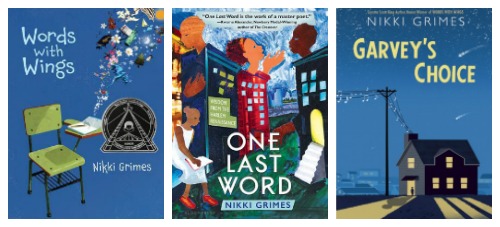
Nikki Grimes is a new favorite author/poet of mine. I loved all three of these and am delighted to know there are plenty more backlist titles of hers to explore. Words with Wings and Garvey's Choice are middle grade novels-in-verse and One Last Word is a poetry collection featuring classic Harlem Renaissance poetry and Nikki's original poetry side by side. She uses a really interesting (and difficult!) poetry technique to tie the old and the new poems together. Just fascinating!


* * * * *


Two excellent novels-in-verse and a memoir-in verse (Brown Girl Dreaming). FYI: To Stay Alive is about the Donner Party, so you may want to proceed with caution, though it is very well done and doesn't sensationalize the story.

The Crossover, by Kwame Alexander
Brown Girl Dreaming, by Jacqueline Woodson
To Stay Alive, by Skila Brown

* * * * *

A thought-provoking YA poetry collection based on classic fairy tales that looks at young women, society, expectations, and more. It's been a while since I read this one and I'd like to revisit it. Read an excerpt to get a bit of a feel for it.


* * * * *

I'd love to hear your poetry recommendations -- from picture books to classics or anything in between!


Sunday, April 30, 2017

National Poetry Month

In the US, April is National Poetry Month. To be perfectly honest, I did not read much poetry at all until recently. There were a few poems I read in high school English classes that made me want to like poetry, but any time I tried it on my own without the guidance of a teacher, I ended up feeling pretty lost. Why did those few Emily Dickinson poems resonate so much, while other ones (including other Dickinson poems!) left me scratching my head? Well, I don't fully know the answer to that question, but I think part of it was giving up too soon or expecting to always "get it" on the first try.

On a recent episode of the What Should I Read Next podcast, the guest poet made a really thoughtful point about poetry not being a type of literature we "consume" like we do a page-turning novel, but rather that we can contemplate (paraphrasing here.) I think I was doing a lot more contemplation when I studied these poems in school than when I tried to pluck a poem out of a collection on my own. My teacher didn't analyze those poems to death either (which can really ruin poetry for a lot of people), but she certainly helped us gain more insight and understanding about what we were reading.

So after a few half-hearted tries to read poetry on my own post-school, I mostly abandoned the idea until my son came along and I started reading "children's" poetry. And it kind of felt like a breath of fresh air. I love rhyming poetry which is so common in children's works. Of course, I love poets like Shel Silverstein who write specifically for children, but I've come to realize I also really love poetry collections that are curated/selected for a younger audience from the world of "adult" or "classic" poets. These poems tend to be about subjects particularly resonant for children and/or are just a bit simpler to understand. Well, I think they are also a really excellent place to start for adult readers intimidated by poetry who want to give it a chance.

National Poetry Month ends today, but I think I have more than one post in me on the subject! So I'll start now with a few collections I currently have bookmarks in that I've been enjoying:


Julie Andrews' Treasury for All Seasons: Poems and Songs to Celebrate the Year, selected by Julie Andrews & Emma Walton Hamilton; illustrated by Marjorie Priceman

This is by far my favorite of the books I'm listing today. It's a bright, colorful, and beautiful collection divided first by season and then by month. I've really loved reading this one to my son a little at a time throughout the year. I'm always looking for baby shower book gift ideas that aren't the same classics everyone else thinks of -- and I think this collection would be a really great gift. It covers all sorts of occasions throughout the year and in terms of holidays it includes Christian and Jewish ones as well as secular ones. There are also poems for Ramadan, Kwanzaa, and Chinese New Year.

I have the Audible audiobook in addition to the print which is narrated by Julie Andrews and her daughter. What I've listened to so far is so very lovely, but it's currently mislabeled as unabridged -- there are definitely poems in the print book that are not on the audio. Still a great listen though! I find poetry in general really great to listen to and a talented speaker/performer can help me understand and appreciate a poem better than just reading it on the page.

* * * * *


Days to Celebrate: A Full Year of Poetry, People, Holidays, History, Fascinating Facts, and More, edited by Lee Bennett Hopkins; illustrated by Stephen Alcorn

Divided by month, this collection has some real gems in it. Overall, I'm liking the Julie Andrews collection better, but this is still a very nice collection to read throughout the year.

* * * * *


A Poem for Every Night of the Year, edited by Allie Esiri

I've liked some poems much better than others in this collection. I tend to read them a week or two at a time though, so I probably am going through them too quickly to really appreciate each one. I hope to revisit this in future years and think I will get more out of it each time. While published under a children's imprint, I think this one is aimed more at older kids or teens, though it can most definitely be enjoyed by adults. 
(P.S. It's published in the UK, so I got my copy from The Book Depository. 
P.P.S. While writing this, I came across what looks like a companion anthology coming out this summer! A Poem for Every Day of the Year with another gorgeous, complementing cover!) 

* * * * *


Poetry Speaks Expanded, edited by Elise Paschen & Rebekah Presson Mosby

 This one isn't a children's collection, but I think it's very well done in terms of helping you get a pretty good introduction to various famous poets and their work. I've only read one of the 47 poets so far and keep meaning to get back to it. The best part is the accompanying recordings of the poets reading their own work. Every poet has at least one recording, but not every poem in the collection has a recording, FYI.

* * * * *

If anyone has any poetry recommendations for me -- children's or otherwise -- please share in the comments!


Monday, March 27, 2017

Reading Charlotte's Web as an Adult

Charlotte's Web by E.B. White
Date: 1952
Format: B&N collectible edition (omnibus)
How did I get this book? purchased
Rating: 4 of 5 stars

Charlotte's Web is one of the (many) classics I can't believe I never read as a kid. In fact, there are A LOT of classic children's books (chapter books, novels, and picture books) I "missed" growing up. Even some I may have read, I unfortunately don't recall very well. But instead of looking at them as missed chances, I'm taking the opportunity now to enjoy them as an adult -- and hopefully someday share them with my son. With that in mind, some months back, I revised my Classics Club list to focus on children's classics. Finally reading Charlotte's Web confirms this was a wise decision for me at this stage in my life.

Sure, there are plenty of more "difficult" classics I aspire to tackling someday, but that really isn't where my head is at right now. It's not just that children's classics are "easier" or shorter, though they often are -- and my tired mommy-brain is grateful! Wanting to focus on children's books is more about my frame of mind and priorities right now. Diving head first into picture books with my son as an infant, baby, and now toddler has reminded me how rich and engaging good children's literature can be. So many of these stories (and their artwork!) can be enjoyed by people of all ages, even if they aren't the first thing we might gravitate to as a "grown-ups."

My son may still be too young to appreciate a lot of the books I've been picking up lately, but that's not really the point. The point is that the more I learn about children's books, the more I want to experience them for myself and fill in some of the gaps in my own childhood reading. I know my parents took me to the library and read me picture books, but mostly I just remember reading Nancy Drew, The Babysitters Club, spooky books by Mary Downing Hahn, and the occasional school assignment I actually enjoyed, but that was later in my childhood. I remember my highschool reading vividly, but my younger years are understandably a bit foggy. So why not read those children's classics now? There is no good reason not to read them now, so that is exactly what I am doing and I'm really loving it.

The only (sort-of) downside to reading these childhood classics now is that there isn't any of the nostalgia factor. Charlotte's Web likely would have gotten 5 stars if I had read it as a child, but it was still a very well-written, engaging, and enjoyable story about friendship, determination, and loss. I never was much a fan of spiders, but this fictional tale has helped this scaredy-cat look at them a bit differently and reminded me of their purpose in the natural world. I appreciated that this story didn't sugarcoat some of the harsher realities of life and death on a farm, but it is ultimately a hopeful and uplifting book. It didn't turn me into a vegetarian, though at times I was wondering if the author was trying to! More E.B. White books are on my TBR for sure, namely Stuart Little and The Trumpet of the Swan -- both of which are also in the omnibus edition I read Charlotte's Web from.

In addition to the story, the illustrations for Charlotte's Web are just wonderful and I am fast becoming a fan of Garth Williams' work. Our bookshelves and library basket are filling up with his many picture books and we've found a few new favorites. My son and I have both enjoyed My First Counting Book and Home for a Bunny in particular and look forward to exploring more of this prolific illustrator's books.


Sunday, February 12, 2017

Show and Tell: Exploring the Fine Art of Children's Book Illustration

Show and Tell: Exploring the Fine Art of Children's Book Illustration by Dilys Evans
Publisher: Chronicle Books
Date: March 2008
Format: hardcover
How did I get this book? borrowed from library
Rating: 4 of 5 stars
GoodReads

This was a very informative exploration of picture book art focusing on 12 different illustrators. As the author states, this is not meant to be a "best of" list, but rather she chose a group of artists she felt offered "a wide range of styles, technique, and content" and I feel she certainly delivered on that. All of the featured artists may not be my particular favorites, but I definitely learned a lot by reading more about their work, background, inspirations, and process.

Only three of the featured artists were completely new to me (Trina Schart Hyman, Petra Mathers, and Harry Bliss), but this book piqued my interest in their work -- particularly the prolific Trina Schart Hyman whose chapter I found particularly intriguing. The other nine illustrators (Brian Selznick, Bryan Collier, Paul O. Zelinsky, Hilary Knight, David Wiesner, David Shannon, Betsy Lewin, Denise Fleming, and Lane Smith) I had previously read at least one of their books, but oftentimes it was their most popular work or their Caldecott award-winning work. So even for those artists I previously was somewhat familiar with, I've now been introduced to a broader range of their work. While I probably won't seek out every single one mentioned, I have certainly added to my picture book TBR list! I've already borrowed quite a few from the library and (shocker!) ordered used copies of two out of print titles my library system didn't have.

This sort of deep-dive into picture books and illustration won't be for everyone, but as someone who reads a ton of picture books these days -- both with my son and now on my own -- it is an area I want to learn more about. Out of habit, I still tend to focus on the text more than the art when I read a picture book. So the more I learn about illustration, the more I feel I can appreciate and understand it in its own right.

Sunday, January 15, 2017

Reading Paddington as an Adult

As a kid, I had a Paddington Bear stuffed animal -- in fact, I do believe it's still at my parents' house! We have pictures of me carrying him around (at the park, no less!), but I don't have any memory of reading the Paddington books as a child. If we did read any of them, they likely were the picture book adaptations and not the full-length novels. The picture books are lovely -- and I have a treasury of them on my son's shelves -- but I really wanted to read Paddington's full story and experience it for myself. 

Picture Book Collection

Once I saw that the audiobook of A Bear Called Paddington was narrated by Stephen Fry, I decided to go with that format. He is such a fantastic narrator (and boy do I wish I could listen to the UK audiobooks of Harry Potter he narrates!) and delivers this classic story flawlessly. The only thing missing is the illustrations of the print edition, so I ended up getting a lovely hardcover anniversary edition for our shelves as well. I'd love to get the full series in print someday, but have held off so far since I already have the next few books queued up in my Audible library. 

First full-length novel

The second novel, More About Paddington, is the only other one narrated by Stephen Fry and that is as far as I've gotten in the series thus far. In fact, I've now read them twice and they were just as good the second time through. While the first novel is surely the most well known and widely read, the follow-up was an equally wonderful reading experience for me. Although the books are divided into chapters to be read in sequence, most feel like they can be read as their own stories as well. Particularly once you are past the initial few chapters that introduce Paddington and the Brown family, they start to read more and more like individual adventures within the established framework. I feel much the same about the Winnie-the-Pooh books, as a matter of fact.


Paddington is an endearing character and I can certainly see why his popularity has endured through the decades. He has a knack for getting himself into trouble and it's always interesting to see how he gets himself out of that trouble -- one way or another. Like many well-loved children's book characters, he means well, but mishaps, misadventures, and misunderstandings happen -- and make for great storytelling along the way. The novels are definitely still far above my son's level, but I do look forward to sharing them with him someday. In the meantime, I will continue reading/listening to the rest of the series myself and I'll have to remember to pull down our picture book versions at storytime!

Classics Club #13-14

Tuesday, December 6, 2016

Reading the Art in Caldecott Award Books

Reading the Art in Caldecott Award Books: A Guide to the Illustrations by Heidi K. Hammond & Gail D. Nordstrom
Publisher: Rowman & Littlefield
Date: August 2014
Format: print
How did I get this book? borrowed from library
Rating: 5 of 5 stars
GoodReads | Authors | Publisher

I am participating in Julie's Newbery/Caldecott Challenge this year and was looking to learn more about why certain books win these awards when I found Reading the Art in Caldecott Award Books in my library system's catalog. I borrowed it at least three times and maxed out my renewals each time. Even though I have now read it in its entirety, I am seriously considering buying a copy to have as a reference. It seems to be an academic-type book though, so it is rather pricey for a paperback -- used or new -- so I'm holding out for now. I admit I am exceedingly enthusiastic about picture books these days, but regardless, I still feel like this is a real hidden gem of a book. Realistically, I imagine this book has mostly been used by librarians and teachers, but I think it could have wider appeal to parents if not for the price. Delving more deeply into picture books isn't for everyone, but I'm sure I'm not the only bookish parent who is more comfortable with understanding and appreciating text and wished to know more about the merits of award-winning illustration.

So what exactly will you find in this book? The introduction covers the Caldecott award criteria and the process of choosing the winners. The authors share their own experience serving on the 2011 Caldecott committee (without revealing anything confidential, of course). I know it takes a lot of hard work and dedication, but it sure sounded like fun for anyone who loves picture books! The authors also explain how and why they wrote the book and how to use it. It is important to know it is not meant to be read alone, but rather to be read alongside the picture books themselves so you can examine the illustrations more closely as you learn more about them.

After the introduction, we move right into entries for 56 different Caldecott award books. The entries are presented alphabetically by title and include all of the Medal and Honor books for 2011-2014 plus selected titles from earlier years. It doesn't cover nearly all of the Caldecott titles going back to 1938, but there is enough here to give you a solid foundation for better understanding how the award works and what qualifies a book to receive it. I would love if the authors wrote a follow-up featuring additional Caldecott books, but I don't know how realistic that wish is!

Each entry lists the title, author, medal or honor status, year, style, and medium. Then there four sections: "analysis," "for further consideration," "illustrator note," and "sources consulted." Each entry is not long, but they are packed full of insights and observations about the book and its artwork. You can read the entry for The Invention of Hugo Cabret excerpted on the authors' website here to see an example.

My usual method was to read the picture book once, then read its entry while flipping back through the picture book and examining it more closely. I cannot even begin to count how many times I missed things in the illustrations. And while most of the time, I felt like my biggest takeaway was to just pay better attention already! -- there were many other cases where additional background information was provided that I never would have known without additional research. And as easy as it sounds to just pay better attention, many years of focusing primarily on the written words is a hard habit to break. The other thing this book was really good at was pointing out "threads" in the illustrations -- for example, a minor character or image that appears on every page. I am terrible at picking up that sort of thing on my own unless it is glaringly obvious. I am definitely not well-practiced in noticing more subtle things in picture book artwork.

There is a glossary which proved extremely useful as I encountered unfamiliar terms. There are also three different indexes so you can easily identify picture books by media and style as well as by title/author/illustrator. The "sources consulted" listed for each entry (in addition to the sources listed in one of the back appendixes) are proving to be a treasure trove of additional reading. I've started looking for some of them in my library system and plan to continue delving into the world of picture books. I have a feeling I've started down a bit of a rabbit hole here, but I'm definitely OK with that. Apologies to anyone who isn't so interested in picture books, but this "genre" is even more vast and more fascinating than I first imagined and I won't be leaving it any time soon!

Monday, November 28, 2016

Current Children's Book Favorites

I always thought I would never tire of reading to my son, and for the most part that is still true. I know toddlers and little kids thrive on repetition, so I'm not surprised he gravitates toward the same books over and over. However, I must admit when we get to the fifth reading in a row, I very much do wish we could switch to something different! He does have many favorites though, so I really can't complain. I am so thankful my little boy enjoys stories, being read to, and (most of the time) snuggling up for this part of our day. So I thought I would share the most recent batch we -- sorry, he -- has on rotation.


Hippos Go Beserk! by Sandra Boynton
What's Wrong Little Pookie? by Sandra Boynton
One, Two, Three by Sandra Boynton
Barnyard Dance by Sandra Boynton
Little Blue Truck by Alice Schertle & Jill McElmurry (Illus.)
I Love You Through and Through by Bernadette Rossetti-Shustak & Caroline Jayne Church (Illus.)
Zoom Buggy! by Claire Clark & Jay Jung (Illus.)


Ten Little Fingers and Ten Little Toes by Mem Fox & Helen Oxenbury (Illus.)
Little Blue Truck Leads the Way, by Alice Schertle & Jill McElmurry (Illus.)
We're Going on a Bear Hunt by Michael Rosen & Helen Oxenbury (Illus.)

Not pictured:
Five Little Ducks by Raffi and Jose Aruego & Ariane Dewey (Illus.)

The first photo was actually taken a month ago, so the second photo shows additions since then. A few in the second photo, he honestly didn't care for at first. It's amusing to see him reject a book (translation: shut it mid-sentence) only to warm up to it later. I'm stubborn about expanding his repertoire though. I know he is protesting for no other reason than because the story doesn't sound familiar, so I just keep trying. Sometimes I read new books when he is more sleepy and agreeable to letting me choose our story. Other times, I sit in the rocking chair and read aloud while he plays in the same room. And plenty of times, a "rejected" book has become a new favorite. So I always try to remember that when I excitedly crack open a new book, only to have him pull it away, shut it, or declare "no, no, no!"

* * * * *

If anyone has any children's book recommendations, I'd love to hear them! And I hope everyone celebrating had a lovely Thanksgiving :)